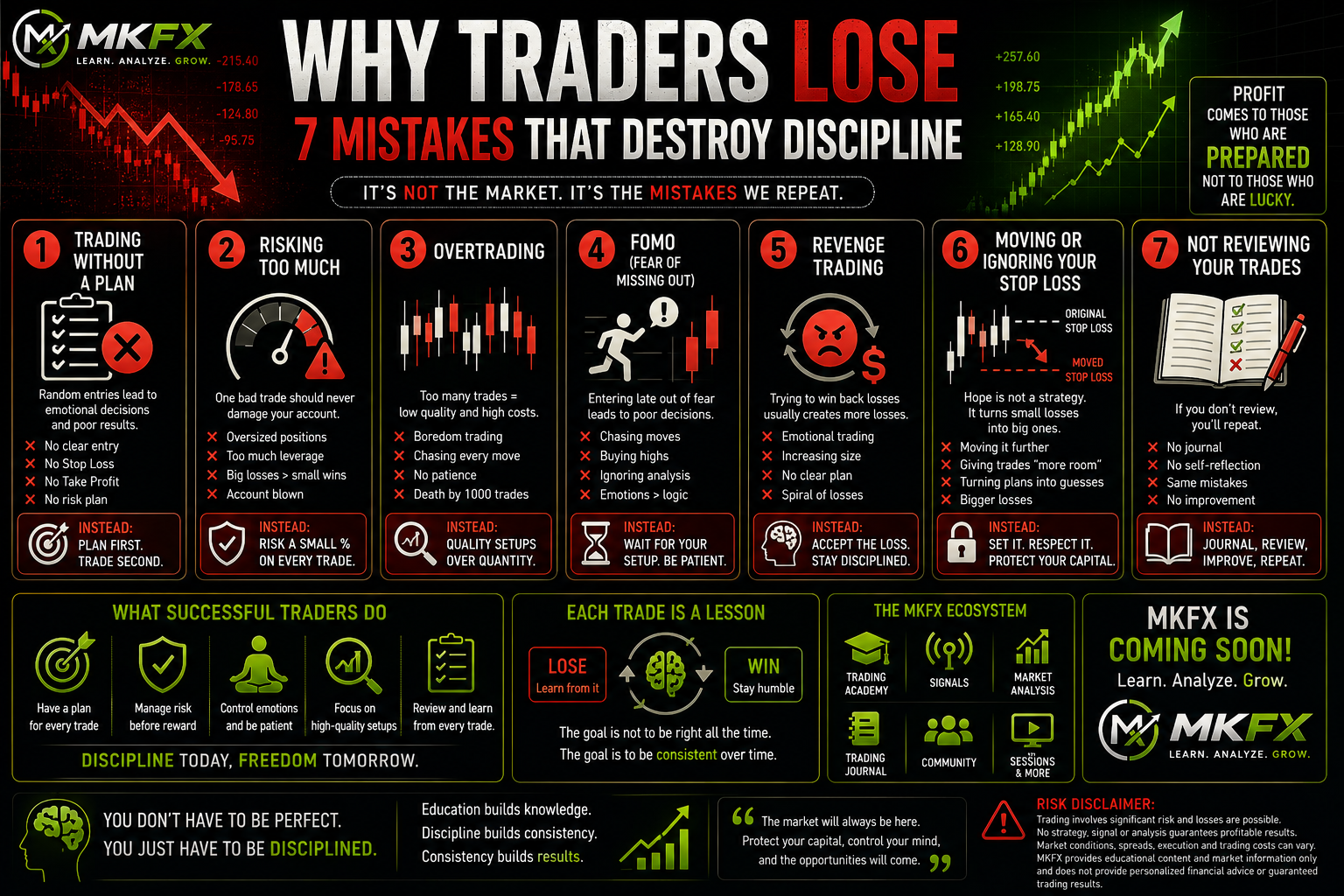
Why Traders Lose: 7 Common Mistakes Beginner Traders Make
Trading can look simple from the outside.
BUY when you think price will rise.
SELL when you think price will fall.
But consistently making disciplined trading decisions is much more difficult.
Beginners often focus heavily on finding the perfect strategy, indicator or signal while overlooking risk management, psychology and discipline.
Here are seven common mistakes new traders should understand.
1. Trading Without a Plan
Entering a trade simply because the market appears to be moving is not a structured trading strategy.
Before entering a position, a trader should consider:
- Why am I entering?
- Where is my entry?
- Where is my Stop Loss?
- Where is my Take Profit?
- How much am I risking?
- What would invalidate my idea?
Without a plan, decisions can quickly become emotional.
PLAN FIRST. TRADE SECOND.
2. Risking Too Much
A trader may have excellent analysis and still experience losing trades.
No setup is guaranteed.
Risking too much capital on one position means a single mistake or unexpected market movement can cause significant damage to an account.
Important factors include:
- Position size
- Leverage
- Stop Loss distance
- Account size
- Existing market exposure
- Current volatility
Your first objective should not simply be trying to make as much money as possible.
Protecting your trading capital matters too.
3. Overtrading
More trades do not automatically mean more profit.
Overtrading can happen when traders:
- Enter low-quality setups
- Trade because they are bored
- Feel they must always be in the market
- Chase every price movement
- Try to recover losses quickly
- Ignore their normal trading criteria
Sometimes the best trading decision is:
NO TRADE.
Patience is part of trading.
Waiting for conditions that match your trading plan can be just as important as knowing when to enter.
4. FOMO — Fear of Missing Out
Imagine watching Gold, Bitcoin or EUR/USD suddenly move rapidly.
You were not in the trade.
Now you feel like you are missing an opportunity.
You enter late without proper analysis because you do not want to miss the move.
That is FOMO — Fear Of Missing Out.
FOMO can lead traders to:
- Enter without proper analysis
- Chase price after a large movement
- Ignore their planned entry criteria
- Take excessive risk
- Enter because of excitement rather than structure
By the time a trader enters, the market may already be extended or approaching an important technical area.
There will always be another opportunity.
Do not let excitement replace analysis.
5. Revenge Trading
You lose a trade.
You are frustrated.
Instead of reviewing what happened, you immediately enter another position.
Maybe you increase your position size because you want to recover the loss faster.
This is known as revenge trading.
One controlled loss can quickly turn into several emotional losses.
Revenge trading can involve:
- Entering another trade immediately after a loss
- Increasing position size
- Ignoring the normal strategy
- Taking setups that would normally be rejected
- Trying to force the market to return previous losses
Accepting that losing trades happen is part of risk management.
THE MARKET DOES NOT OWE YOU YOUR MONEY BACK.
6. Moving or Ignoring Your Stop Loss
Imagine your trading plan says:
STOP LOSS: 1.0950
Price approaches 1.0950.
Instead of accepting the planned loss, you move your Stop Loss farther away.
Then you move it again.
And again.
A controlled loss can become significantly larger because the trader refuses to accept that the original trading idea may have been wrong.
A Stop Loss should form part of a defined risk-management plan.
Market conditions can sometimes justify adjustments within a tested strategy, but moving risk simply because you hope price will return is not disciplined planning.
The important question is:
Am I adjusting this trade because my strategy tells me to, or because I do not want to accept the loss?
7. Not Reviewing Your Trades
A trader makes a mistake.
Then makes the same mistake next week.
Then again next month.
Without reviewing trading decisions, it can be difficult to identify repeated behavioural patterns.
A trading journal can help record:
- Entry and exit
- Stop Loss
- Take Profit
- Position size
- Profit or loss
- Reason for entering
- Market conditions
- Emotional state
- Mistakes
- Lessons learned
The goal is not only to record whether a trade won or lost.
Ask yourself:
DID I FOLLOW MY PLAN?
A losing trade that followed a structured strategy is not necessarily evidence of poor execution.
Likewise, a profitable trade taken recklessly does not automatically mean the decision-making process was good.
Review the process, not only the result.
Bonus Mistake: Chasing the "Perfect Strategy"
Beginners can spend enormous amounts of time searching for:
- "The best indicator"
- "The perfect strategy"
- "A 100% win rate"
- "A signal that never loses"
Markets involve uncertainty.
No legitimate trading strategy can guarantee that every trade will be profitable.
Instead of chasing perfection, focus on developing:
KNOWLEDGE + RISK MANAGEMENT + DISCIPLINE + CONSISTENCY
A strategy does not need to win every trade to be useful.
What matters is understanding how the strategy works, how risk is controlled and whether the trader can follow it consistently.
Learn From Your Losses
Losses should not automatically be ignored.
They can provide useful information.
After a losing trade, consider asking:
- Was my analysis wrong?
- Was my risk too high?
- Did I follow my plan?
- Was I trading emotionally?
- Did I enter because of FOMO?
- Was I trying to recover a previous loss?
- Did I ignore market structure?
- Was my position size appropriate?
- What could I improve next time?
This is how a trading journal can become a learning tool rather than simply a record of profit and loss.
A Profitable Trade Can Still Be a Bad Trade
This is an important concept for beginner traders.
Imagine a trader enters without analysis, uses excessive leverage, ignores risk management and happens to make a profit.
The trade was profitable.
But was the decision-making process good?
Not necessarily.
Now imagine another trader follows a structured plan, manages risk correctly and the market still reaches their Stop Loss.
The trade lost money, but the trader may still have followed their process correctly.
This is why traders should avoid judging every decision only by whether the final result was positive or negative.
How MKFX Helps Traders Build Better Habits
MKFX is built around more than simply providing market signals.
The MKFX ecosystem brings together:
- MKFX Academy — structured trading education
- Educational Trading Signals — trade ideas members can study and review
- Market Analysis — technical observations, market context and possible scenarios
- Trading Journal — record and review trading activity
- Community — connect with other MKFX members
- Live Sessions — available according to membership access
The goal is to help members develop their knowledge, analyse their decisions and understand their mistakes.
A signal can show you an idea.
Education can help you understand it.
Market analysis can provide context.
A journal can help you evaluate yourself.
Discipline determines what you do next.
Build Discipline, Not Perfection
Trading mistakes cannot always be eliminated completely.
But they can be identified, reviewed and managed more effectively.
The objective is not to become a trader who never experiences losses.
The objective is to become more aware of your decisions, more disciplined with risk and more consistent with your process.
DON'T CHASE PERFECTION.
BUILD DISCIPLINE.
MANAGE YOUR RISK.
LEARN FROM YOUR MISTAKES.
MKFX
LEARN. ANALYZE. GROW.
Powered by MKTECHSUPPORT (PTY) LTD
Risk Disclaimer: Trading involves significant risk and losses are possible. No trading strategy, educational signal, indicator or form of market analysis guarantees profitable results. Risk-management techniques cannot eliminate all losses. MKFX provides trading education, market insights, educational trading signals and related tools. Nothing contained in this article constitutes personalised financial advice or guarantees trading results.