What Is Forex Trading?
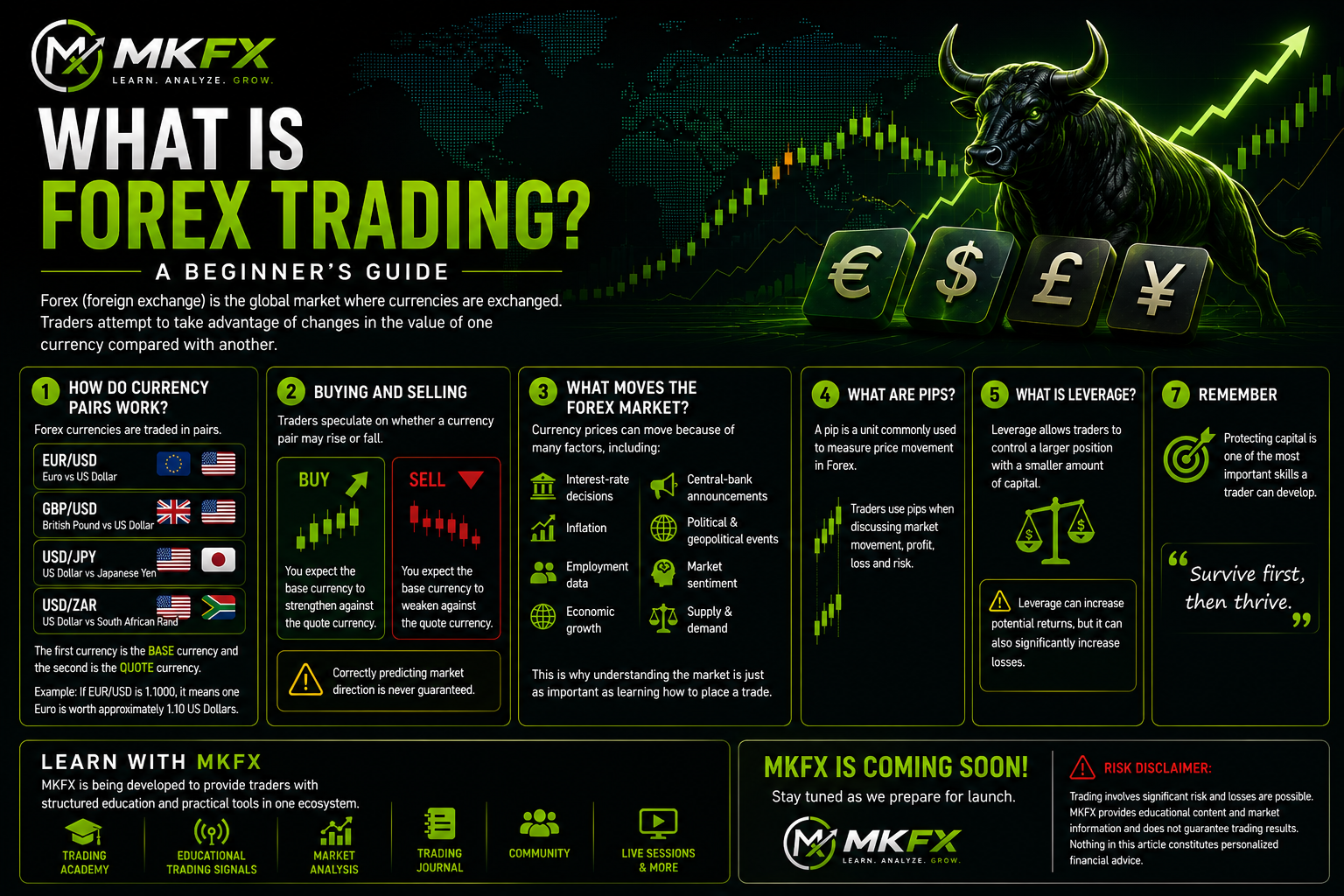
Forex, short for foreign exchange, is the global market where currencies are exchanged.
If you have ever exchanged South African Rand for US Dollars, Euros or another currency, you have already participated in a form of foreign exchange.
Forex traders attempt to take advantage of changes in the value of one currency compared with another.
However, trading Forex involves risk, and correctly predicting future currency movements is never guaranteed.
How Do Currency Pairs Work?
Forex currencies are quoted and traded in pairs.
Examples include:
- EUR/USD — Euro vs US Dollar
- GBP/USD — British Pound vs US Dollar
- USD/JPY — US Dollar vs Japanese Yen
- USD/ZAR — US Dollar vs South African Rand
Every currency pair contains two currencies:
BASE CURRENCY / QUOTE CURRENCY
The first currency is called the base currency, while the second is called the quote currency.
For example:
EUR/USD = EURO vs US DOLLAR
If EUR/USD is trading at 1.1000, it means one Euro is worth approximately 1.10 US Dollars.
Buying and Selling Forex
Forex traders can speculate on whether the value of a currency pair may rise or fall.
BUY
When a trader BUYS a currency pair, they generally expect the base currency to strengthen relative to the quote currency.
For example, someone buying EUR/USD generally expects the Euro to strengthen relative to the US Dollar.
SELL
When a trader SELLS a currency pair, they generally expect the base currency to weaken relative to the quote currency.
For example, someone selling EUR/USD generally expects the Euro to weaken relative to the US Dollar.
Correctly predicting market direction is never guaranteed.
What Moves the Forex Market?
Currency prices can move because of many economic, political and market-related factors.
Traders may monitor:
- Interest-rate decisions
- Inflation
- Employment data
- Economic growth
- Central-bank announcements
- Political developments
- Geopolitical events
- Market sentiment
- Risk appetite
- Supply and demand
Because a Forex pair contains two currencies, developments affecting either currency can influence the pair's price.
This is why understanding the market is just as important as learning how to place a trade.
What Are Pips?
A pip is a commonly used unit for measuring price movement in Forex.
For many currency pairs, one pip corresponds to the fourth decimal place.
For example:
EUR/USD: 1.1000 → 1.1001 = 1 pip
Traders use pips when discussing:
- Market movement
- Stop Loss distances
- Take Profit distances
- Potential profit
- Potential loss
- Trade risk
Quoting conventions can differ for certain currency pairs, including many JPY pairs, and some brokers display fractional pips using additional decimal places.
What Is a Spread?
Forex markets are commonly displayed using a Bid price and an Ask price.
The difference between these prices is known as the spread.
For example:
- Bid: 1.1000
- Ask: 1.1002
The difference between these two prices forms part of the cost of entering and exiting a trade.
Spreads can vary depending on the currency pair, broker, liquidity, volatility and current market conditions.
What Is Leverage?
Leverage allows traders to control a larger market position using a smaller amount of their own capital.
This can increase market exposure.
While leverage can magnify potential gains, it can also significantly magnify losses.
A relatively small market movement against a highly leveraged position can have a large effect on a trading account.
Beginners should understand leverage, margin and position sizing before using leveraged trading products.
What Is Margin?
Margin is closely related to leverage.
It generally refers to the amount of funds required to open or maintain a leveraged position, depending on the broker and trading product.
Using leverage does not remove risk.
In fact, greater market exposure can increase the effect that price movements have on an account.
Traders should understand the margin requirements and rules of their broker before opening leveraged positions.
What Are Stop Loss and Take Profit?
A Stop Loss (SL) is a predetermined level intended to close a position if the market moves against the trader.
A Take Profit (TP) is a predetermined level intended to close a position if the market moves in the trader's favour.
These levels can form part of a structured trading and risk-management plan.
However, Stop Loss and Take Profit orders do not guarantee execution at the exact requested price under every market condition.
Understanding Position Size
Position size determines how much exposure a trader has to a market movement.
Two traders can enter the same currency pair at the same price and use the same Stop Loss distance while risking very different amounts because their position sizes are different.
Before entering a trade, traders should consider:
- Account size
- Position size
- Stop Loss distance
- Amount at risk
- Current volatility
- Available margin
- Existing market exposure
Understanding how much you could lose is an important part of planning a trade.
Forex Trading Sessions
The Forex market operates across major financial centres around the world.
Traders commonly refer to major trading sessions such as:
- Asian session
- London session
- New York session
Different currency pairs may experience different levels of activity depending on the time of day and which financial centres are active.
Liquidity and volatility can also change when major sessions overlap or when important economic information is released.
Risk Management Matters
Learning how to enter a trade is only one part of trading.
Traders should also understand:
- Stop Losses
- Take Profit levels
- Position sizing
- Risk-to-reward
- Account exposure
- Leverage and margin
- Trading psychology
- Market volatility
- When not to trade
No trading strategy or market analysis can eliminate uncertainty.
Protecting capital and controlling risk are important parts of developing as a trader.
Trading Psychology Matters Too
Technical knowledge alone does not automatically create disciplined trading decisions.
Traders can also be affected by emotions such as:
- Fear
- Greed
- FOMO
- Frustration
- Overconfidence
- Revenge trading
A trading plan and journal can help traders review whether their decisions were based on analysis and structured rules rather than uncontrolled emotion.
Start with a Demo Account
Beginners may consider practising on a demo trading account before deciding whether to trade with real money.
A demo account can help you practise:
- Navigating a trading platform
- Opening and closing positions
- Setting Stop Loss and Take Profit levels
- Understanding position sizes
- Reading currency pairs
- Testing a trading process
However, successful demo trading does not guarantee successful live trading.
Live trading introduces real financial risk and emotional pressure that may not be experienced in the same way when using virtual funds.
Learn Forex with MKFX
The MKFX Academy provides structured education designed to help members develop their understanding of Forex and other supported financial markets.
The MKFX ecosystem brings together:
- MKFX Academy — structured trading courses and lessons
- Educational Trading Signals — trade ideas members can study and review
- Market Analysis — technical observations, market context and possible scenarios
- Trading Journal — record and review trading activity
- Community — connect with other MKFX members
- Live Sessions — available according to membership access
Whether you are completely new to Forex or looking to strengthen your existing knowledge, MKFX provides a structured environment where you can continue learning and developing.
Our goal is not simply to show traders where they could BUY or SELL.
We want members to understand what they are trading, why markets move, how risk works and how their own decisions affect their trading process.
Learn Before You Trade
Forex trading is more than predicting whether a chart will move up or down.
Understanding currency pairs, pips, spreads, leverage, position sizing, market analysis and risk management provides a stronger foundation for learning how the Forex market works.
Take the time to learn.
Practise what you learn.
Review your decisions.
And never assume that any trade is guaranteed.
LEARN THE FUNDAMENTALS.
UNDERSTAND THE MARKET.
MANAGE THE RISK.
REVIEW YOUR PROGRESS.
MKFX
LEARN. ANALYZE. GROW.
Powered by MKTECHSUPPORT (PTY) LTD
Risk Disclaimer: Forex and leveraged trading involve significant risk and losses are possible. Leverage can magnify both gains and losses, and market conditions may affect spreads, pricing and order execution. Stop Loss orders may not always execute at the exact requested price. MKFX provides trading education, market insights, educational trading signals and related tools. MKFX is not a broker and does not execute trades on behalf of members. Nothing contained in this article constitutes personalised financial advice or guarantees future trading results.