Understanding Forex Currency Pairs: Majors, Minors & Exotics
When you trade Forex, you are not trading a single currency by itself.
Currencies are quoted and traded in pairs.
You have probably seen symbols such as:
- EUR/USD
- GBP/USD
- USD/JPY
- USD/ZAR
But what do they actually mean?
Understanding currency pairs is one of the first steps toward learning how the Forex market works.
What Is a Currency Pair?
A Forex pair compares the value of one currency with another.
For example:
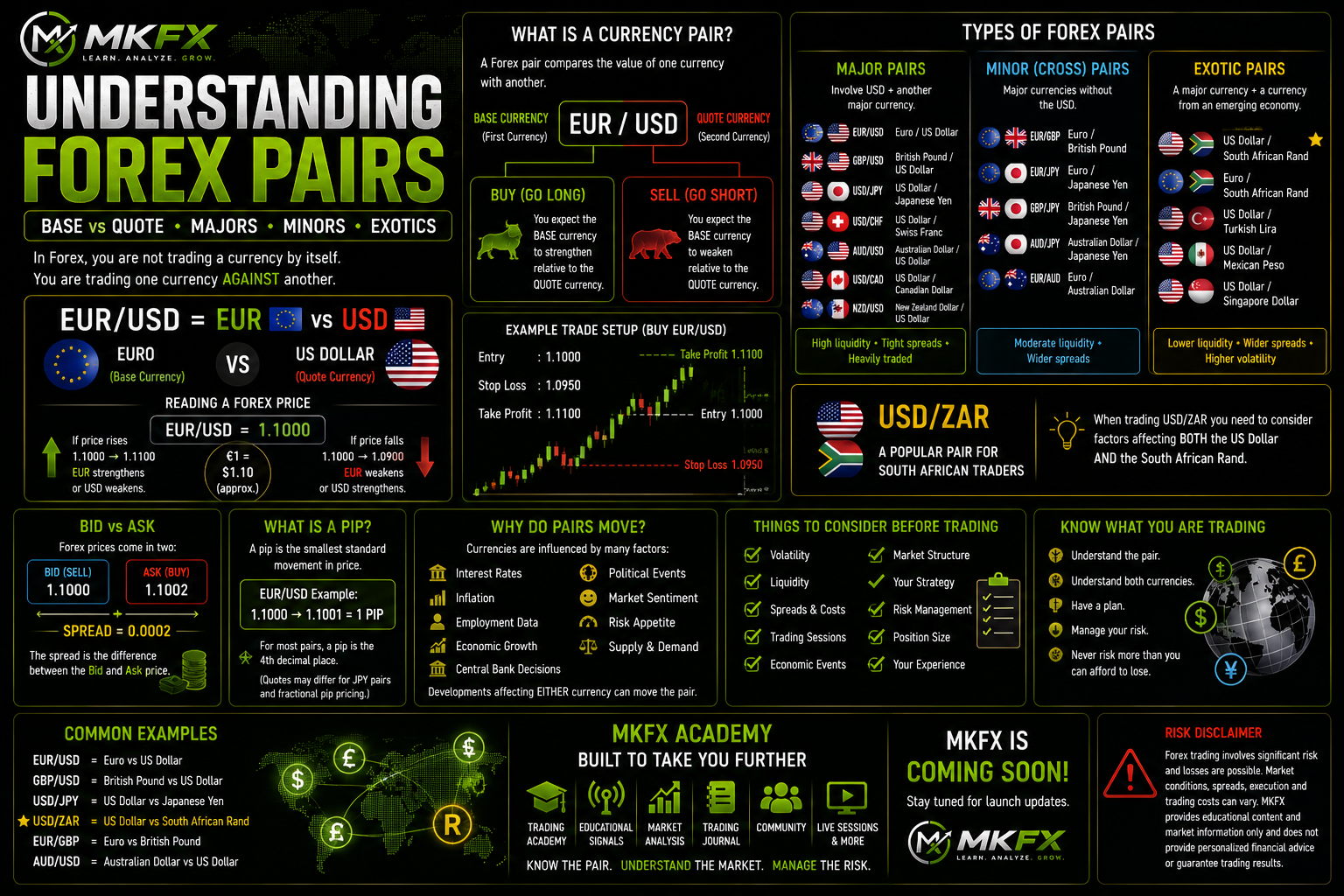
EUR/USD = EURO vs US DOLLAR
If EUR/USD is trading at 1.1000, this means one Euro is worth approximately 1.10 US Dollars.
Every Forex pair contains two currencies:
BASE CURRENCY / QUOTE CURRENCY
In EUR/USD:
- EUR = Base Currency
- USD = Quote Currency
The base currency is the first currency in the pair.
The quote currency is the second currency.
Reading a Forex Price
Imagine:
EUR/USD = 1.1000
This means:
€1 = approximately $1.10
If EUR/USD rises from:
1.1000 → 1.1100
the Euro has strengthened relative to the US Dollar.
If EUR/USD falls from:
1.1000 → 1.0900
the Euro has weakened relative to the US Dollar.
Buying a Currency Pair
When a trader BUYS EUR/USD, they generally expect the Euro to strengthen relative to the US Dollar.
In simple terms:
BUY = Expect the base currency to strengthen relative to the quote currency.
This could happen because the base currency strengthens, the quote currency weakens or a combination of both.
Selling a Currency Pair
When a trader SELLS EUR/USD, they generally expect the opposite.
SELL = Expect the base currency to weaken relative to the quote currency.
Remember:
This is market speculation.
There is no guarantee that price will move in the expected direction.
What Are Major Forex Pairs?
Major currency pairs generally involve the US Dollar together with another heavily traded currency.
Common examples include:
- EUR/USD — Euro / US Dollar
- GBP/USD — British Pound / US Dollar
- USD/JPY — US Dollar / Japanese Yen
- USD/CHF — US Dollar / Swiss Franc
- AUD/USD — Australian Dollar / US Dollar
- USD/CAD — US Dollar / Canadian Dollar
- NZD/USD — New Zealand Dollar / US Dollar
Major pairs tend to receive significant market attention and often have relatively high liquidity.
They may also have tighter spreads than less actively traded pairs, although this can vary depending on the broker and market conditions.
What Are Minor Pairs?
Minor pairs, sometimes called cross-currency pairs, generally involve major currencies without the US Dollar.
Examples include:
- EUR/GBP
- EUR/JPY
- GBP/JPY
- AUD/JPY
- EUR/AUD
For example:
GBP/JPY = British Pound vs Japanese Yen
The US Dollar does not appear in the pair.
Minor pairs can still be actively traded, but their volatility and trading costs can differ significantly from one pair to another.
What Are Exotic Pairs?
Exotic currency pairs generally combine a major currency with the currency of a smaller or emerging economy.
One relevant example for South African traders is:
USD/ZAR
- USD = US Dollar
- ZAR = South African Rand
Other examples may include:
- EUR/ZAR
- USD/TRY
- USD/MXN
Exotic pairs can behave differently from heavily traded major pairs.
Depending on market conditions and the trading venue, they may have:
- Wider spreads
- Lower liquidity
- Greater volatility
- Different trading costs
- Larger price movements during certain events
These characteristics can increase trading risk.
What Is a Spread?
When viewing a Forex market, you may see two prices:
BID and ASK
The difference between these prices is known as the spread.
For example:
- Bid: 1.1000
- Ask: 1.1002
Spread = 0.0002
The spread is one of the trading costs a trader should understand before entering a position.
Trading costs and spread behaviour can vary depending on:
- The broker
- The currency pair
- Liquidity
- Time of day
- Market volatility
- Economic announcements
What Is a Pip?
A pip is a commonly used unit for measuring Forex price movement.
For many currency pairs, one pip corresponds to the fourth decimal place.
Example:
EUR/USD
1.1000 → 1.1001 = 1 pip
However, quoting conventions can differ between currency pairs and brokers.
For many JPY pairs, a pip is commonly associated with the second decimal place.
Some brokers also quote fractional pips using an additional decimal place.
Why Do Different Currency Pairs Move?
Currencies are influenced by economic, political and financial-market conditions.
Traders may monitor factors such as:
- Interest rates
- Inflation
- Employment data
- Economic growth
- Central-bank decisions
- Political developments
- Market sentiment
- Risk appetite
- Supply and demand
Because every Forex pair contains two currencies, developments affecting either side of the pair can influence price.
For Example: USD/ZAR
Imagine you are analysing USD/ZAR.
You may need to consider factors affecting:
THE US DOLLAR
and
THE SOUTH AFRICAN RAND
This could include economic developments from both the United States and South Africa.
For example, traders may monitor:
- US interest-rate expectations
- South African Reserve Bank decisions
- Inflation data
- Employment figures
- Economic growth
- Political developments
- Global investor risk sentiment
This is why Forex analysis involves understanding relationships between currencies rather than studying only one side of the pair.
Trading Sessions Can Affect Currency Pairs
The Forex market operates across different global trading sessions.
Major sessions include:
- Asian session
- London session
- New York session
Different currency pairs may become more active during different parts of the trading day.
For example, European currency pairs may receive increased activity during the London session, while USD-related markets can become especially active during the New York session.
This does not mean a pair will always move strongly during a particular session, but understanding when markets are most active can help traders understand liquidity and volatility.
Which Pair Should Beginners Trade?
There is no single currency pair that is automatically best for every beginner.
Before trading any pair, learn about:
- Typical volatility
- Trading costs
- Liquidity
- Trading sessions
- Economic events
- Market structure
- Spread behaviour
- Risk involved
Instead of trying to trade every available market, beginners may find it easier to study a smaller number of currency pairs more deeply.
This can make it easier to become familiar with how those markets respond to different conditions.
Know What You Are Trading
Do not enter EUR/USD simply because someone says:
"BUY EUR/USD."
Understand what the symbol means.
Understand which currencies you are analysing.
Understand why the market may be moving.
Understand the spread and trading costs.
Understand where your trading idea becomes invalid.
And most importantly:
Understand your risk before entering.
Currency Pairs and Risk Management
Different currency pairs can have very different volatility characteristics.
A position size that may appear manageable on one pair could create significantly different exposure on another.
Before entering a Forex position, traders should consider:
- Account size
- Position size
- Stop Loss distance
- Pip value
- Current volatility
- Spread
- Leverage
- Existing account exposure
The name of the currency pair does not determine how much risk you should take.
Risk should be considered based on the individual trade, your account and your own trading plan.
Learn Forex with MKFX
The MKFX Academy provides structured Forex education covering foundational concepts and more advanced market topics.
The MKFX ecosystem brings together:
- MKFX Academy — structured trading education
- Educational Trading Signals — trade ideas that members can study and review
- Market Analysis — technical observations, market context and possible scenarios
- Trading Journal — record and review trading activity
- Community — connect with other MKFX members
- Live Sessions — available according to membership access
Our goal is not only to show members potential market opportunities.
We want members to understand what they are analysing, why the market may be moving and what risks are involved.
Know the Pair. Understand the Market.
Understanding currency pairs gives traders a foundation for understanding how the Forex market works.
Before thinking about entries and exits, understand which two currencies are involved and what may be influencing each side of the pair.
KNOW THE PAIR.
UNDERSTAND THE MARKET.
MANAGE THE RISK.
MKFX
LEARN. ANALYZE. GROW.
Powered by MKTECHSUPPORT (PTY) LTD
Risk Disclaimer: Forex trading involves significant risk and losses are possible. Currency prices can be affected by economic events, market volatility, liquidity and other factors. Spreads, execution, leverage and trading costs can vary between brokers and market conditions. MKFX provides trading education, market insights, educational trading signals and related tools. Nothing contained in this article constitutes personalised financial advice or guarantees trading results.