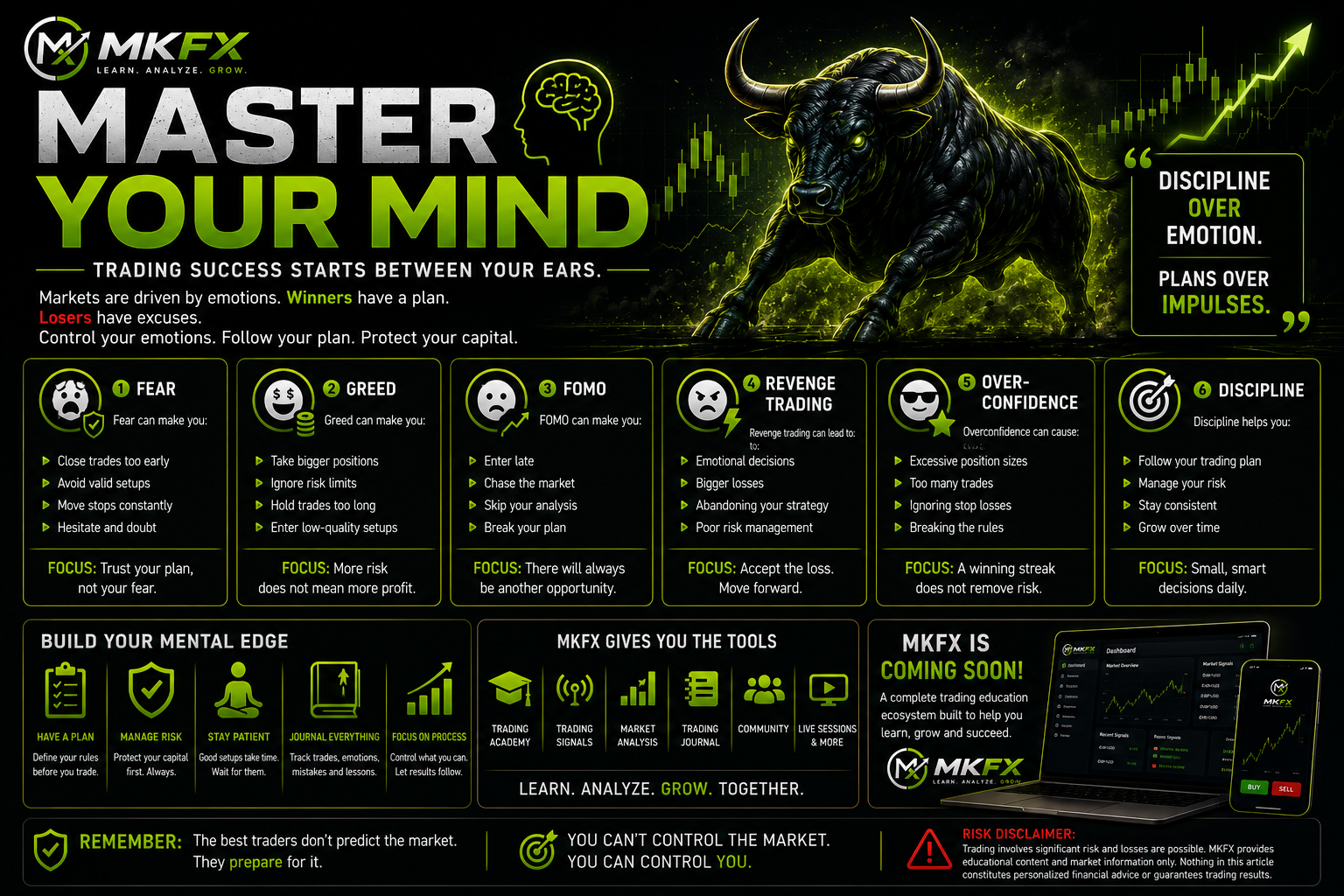
Trading Psychology: Control Your Emotions, Control Your Trading
Trading isn't only about charts, indicators and finding entries.
One of the biggest challenges traders face is managing themselves.
Fear, greed, frustration, overconfidence and FOMO can influence decisions and cause traders to abandon their trading plan.
Understanding trading psychology can help you recognise these behaviours and develop greater discipline.
1. Fear
Fear is a natural response to uncertainty and risk. However, when fear begins controlling trading decisions, it can interfere with a trader's plan.
Fear can cause traders to:
- Close trades too early
- Avoid setups that meet their trading criteria
- Constantly change their Stop Loss
- Hesitate when following their trading plan
- Make decisions based on panic rather than analysis
Risk should always be respected, but trading decisions should ideally be based on a structured plan rather than panic.
2. Greed
After experiencing profitable trades, it can become tempting to take bigger positions or chase larger returns.
Greed can lead traders to:
- Increase position sizes unnecessarily
- Ignore established risk limits
- Stay in trades longer than originally planned
- Enter low-quality setups
- Take additional trades without proper analysis
More risk does not automatically mean better results.
A profitable trade can create confidence, but it should not become a reason to abandon risk-management rules.
3. FOMO
FOMO means Fear Of Missing Out.
Imagine watching a market move rapidly while you're not in the trade.
You may feel tempted to enter simply because the price is moving and you do not want to miss the opportunity.
This can result in:
- Entering without proper analysis
- Entering too late
- Chasing price after a large movement
- Ignoring your normal entry criteria
- Taking a trade that was never part of your original plan
There will always be another market opportunity.
Missing one move is not a reason to abandon your trading process.
4. Revenge Trading
A losing trade can be frustrating.
Some traders immediately try to recover their loss by entering another trade, increasing their position size or abandoning their normal strategy.
This behaviour is commonly known as revenge trading.
The problem is that the next decision may no longer be based on market analysis or a trading plan. Instead, it may be driven by the desire to recover money as quickly as possible.
One emotional decision can potentially turn a manageable loss into a much larger one.
Accepting that losing trades are possible is an important part of developing trading discipline.
5. Overconfidence
Losing trades are not the only events that can affect trading psychology. Winning trades can influence behaviour too.
Several successful trades may cause a trader to feel unusually confident or believe that they cannot be wrong.
Overconfidence can lead to:
- Excessive position sizes
- Taking too many trades
- Ignoring Stop Loss rules
- Breaking risk-management rules
- Taking lower-quality setups
- Assuming previous success will automatically continue
A winning streak does not remove market risk.
Every new trade still carries uncertainty regardless of what happened in previous trades.
6. Develop a Trading Plan
A trading plan can provide structure before emotions become involved.
Instead of making every decision while a market is moving, traders can establish rules beforehand.
A trading plan may define:
- Markets or instruments you trade
- Trading sessions or times you monitor
- Conditions required before entering
- Entry criteria
- Stop Loss rules
- Take Profit rules
- Position-sizing rules
- Maximum acceptable risk
- Conditions where a setup becomes invalid
- When you should not trade
The purpose is to make important decisions before pressure and emotion influence you.
A trading plan cannot guarantee profitable results, but it can provide a framework for making more structured decisions.
7. Keep a Trading Journal
Your trading journal shouldn't only record numbers.
Record how you felt too.
After a trade, consider questions such as:
- Was I confident?
- Was I calm?
- Was I afraid?
- Was I becoming greedy?
- Was I experiencing FOMO?
- Was I frustrated?
- Was I trying to recover a previous loss?
- Did I actually follow my trading plan?
Then record your mistakes, observations and what you learned from the trade.
Over time, your journal can help you identify behavioural patterns that may otherwise be difficult to notice.
You might discover, for example, that certain mistakes repeatedly happen after a loss, during periods of overconfidence or when you trade without following your normal process.
This Is Why MKFX Tracks More Than Trades
The MKFX Trading Journal helps members record their trading activity together with information that can help them review their decision-making process.
Combined with the MKFX Academy, educational trading signals, market analysis and other platform tools, MKFX aims to help members develop both their market knowledge and their trading discipline.
The objective is not simply to record whether a trade made or lost money.
Members should also be able to review questions such as:
- Why did I enter?
- Did the setup match my plan?
- Did I manage my risk correctly?
- Did emotion influence my decision?
- Did I follow my original Stop Loss and Take Profit plan?
- What mistakes did I make?
- What can I learn from this trade?
A profitable trade does not automatically mean that every decision was good, just as a losing trade does not automatically mean that every decision was bad.
The process matters.
Control What You Can Control
You cannot control what the market will do next.
You can control how much risk you choose to take.
You can control your position size.
You can control whether you follow your trading plan.
You can control whether you chase a market because of FOMO.
You can control whether you increase your risk after a loss.
And you can control how you respond when a trading idea is wrong.
Discipline Over Emotion
Trading discipline does not mean eliminating emotions completely.
Fear, excitement, frustration and disappointment are normal human responses.
The objective is to recognise when those emotions begin influencing your decisions and to have a process that helps prevent them from taking control of your trading.
Learn from your decisions. Review your mistakes. Respect your risk. Follow your process.
DISCIPLINE OVER EMOTION.
MKFX
LEARN. ANALYZE. GROW.
Powered by MKTECHSUPPORT (PTY) LTD
Risk Disclaimer: Trading involves significant risk and losses are possible. Emotional discipline and risk-management techniques cannot guarantee profitable trading results or prevent all losses. MKFX provides trading education, market insights, educational trading signals and related tools. Nothing contained in this article constitutes personalised financial advice or guarantees trading results.