Stop Loss & Take Profit Explained: A Beginner's Guide
Entering a trade is only one part of trading.
Before entering a position, a trader should also think about two important questions:
Where will I exit if I am wrong?
Where will I exit if the market moves in my favour?
This is where Stop Loss and Take Profit levels become important.
What Is a Stop Loss?
A Stop Loss, commonly shortened to SL, is a predetermined level used to help limit potential losses on a trade.
If the market moves against your position and reaches the Stop Loss level, the position is intended to close.
For example:
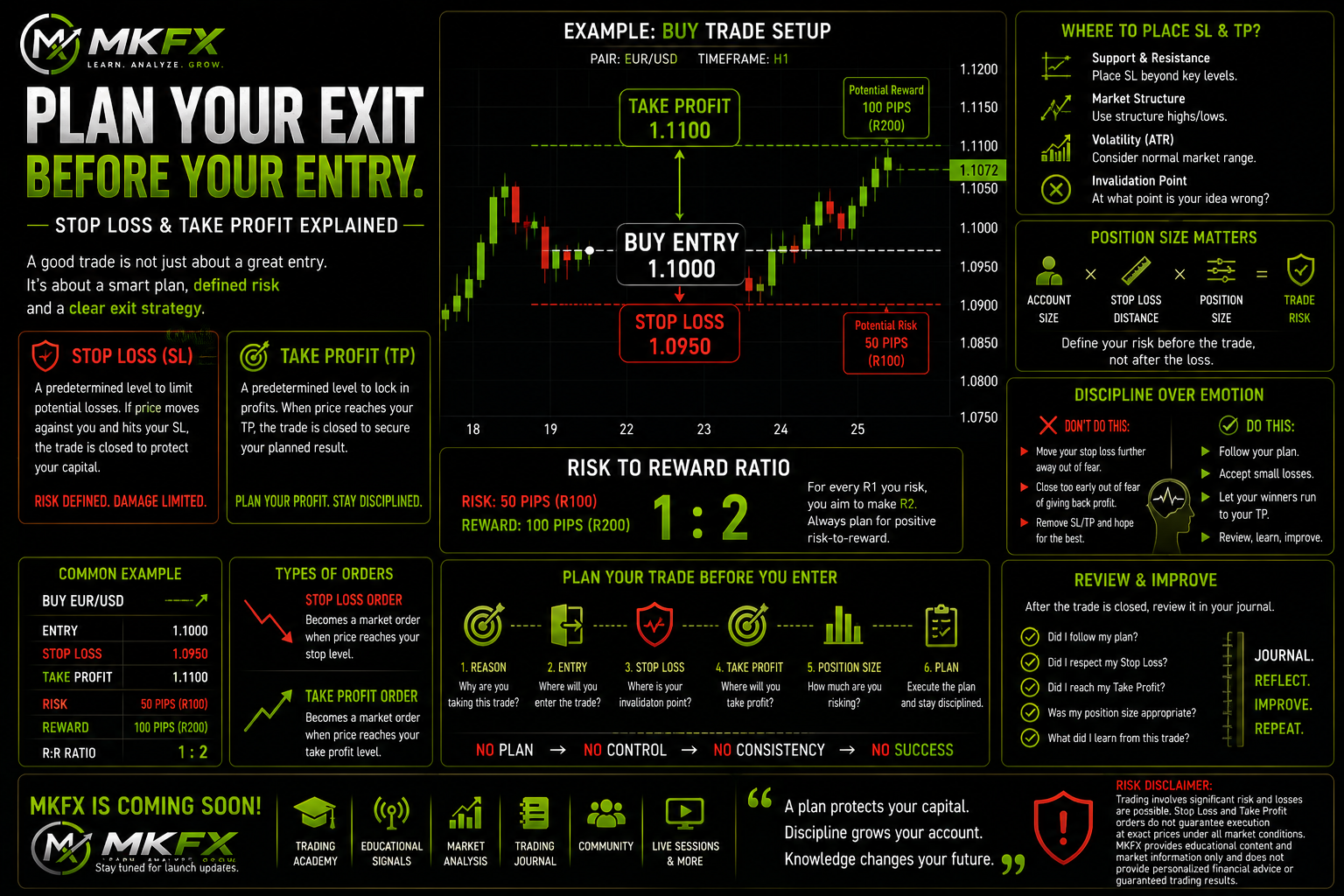
- BUY EUR/USD
- Entry: 1.1000
- Stop Loss: 1.0950
If price moves downward toward 1.0950, the Stop Loss is intended to close the position and limit further loss.
However, execution at the exact Stop Loss price is not guaranteed under all market conditions, particularly during price gaps, low liquidity or extreme volatility.
Why Use a Stop Loss?
Financial markets are unpredictable.
Even a trade setup that appears strong can fail.
A Stop Loss helps a trader define risk before entering the market.
It can help prevent one losing trade from becoming a much larger uncontrolled loss.
The purpose of a Stop Loss is not to guarantee that losses will never occur.
Its purpose is to create structure around how much risk a trader is prepared to accept.
Where Should a Stop Loss Go?
A Stop Loss should not simply be placed at a random distance from the entry price.
Traders may consider factors such as:
- Support and resistance
- Market structure
- Previous highs and lows
- Volatility
- The trade setup
- Position size
- Maximum acceptable risk
One important question to ask is:
At what point is my original trading idea no longer valid?
That area may help determine where risk should be defined.
A Stop Loss that is too close may be triggered by normal market movement, while one that is too far away may expose the account to more risk than intended.
What Is Take Profit?
Take Profit, commonly shortened to TP, is a predetermined level where a trader plans to close a position if price moves in their favour.
For example:
- BUY EUR/USD
- Entry: 1.1000
- Stop Loss: 1.0950
- Take Profit: 1.1100
If price reaches the Take Profit level, the position is intended to close and secure the planned result.
As with other order types, actual execution may depend on the broker, product, liquidity and market conditions.
Why Use Take Profit?
Without an exit plan, emotions can begin influencing trading decisions.
A trader may become greedy and continue holding a profitable position while hoping for a larger return.
The market could then reverse.
Having a planned Take Profit can help create structure before the trade begins.
It gives the trader a predefined area where they intend to realise the result if the market moves according to the original plan.
Understanding Risk-to-Reward
Stop Loss and Take Profit levels can also help traders evaluate risk-to-reward.
Imagine a trade where:
- Potential Risk: R100
- Potential Reward: R200
This represents a:
1:2 RISK-TO-REWARD RATIO
For every R1 being risked, the planned potential reward is R2.
Another example:
- Potential Risk: R100
- Potential Reward: R300
This represents a 1:3 risk-to-reward ratio.
A higher potential reward relative to risk does not guarantee that the trade will succeed.
It simply helps traders compare the planned downside with the planned upside.
Position Size Matters
Knowing where your Stop Loss is located is not enough.
Position size determines how much money may actually be at risk.
Two traders can use the exact same Stop Loss distance but risk very different amounts depending on their position sizes.
This is why traders should consider:
ACCOUNT SIZE + STOP LOSS DISTANCE + POSITION SIZE = TRADE RISK
In practice, the exact monetary risk can also depend on the instrument being traded, contract specifications and currency conversion where applicable.
A larger position size generally means greater exposure to price movement.
Moving Your Stop Loss
One common mistake occurs when price approaches a Stop Loss and the trader keeps moving the Stop Loss farther away.
Why?
Because they do not want to accept the loss.
This can turn a planned, controlled loss into a much larger loss.
Changing a trading plan because of fear, hope or frustration can undermine the original risk-management strategy.
This does not mean a Stop Loss can never be adjusted as part of a defined strategy.
The important difference is whether the adjustment is based on a structured trading rule or an emotional attempt to avoid accepting a loss.
Taking Profit Too Early
The opposite can also happen.
A trader may plan a Take Profit level but close the position almost immediately after seeing a small profit because they are afraid of losing it.
This can interfere with the trader's original strategy and risk-to-reward planning.
The goal is not to blindly refuse adjustments.
The goal is to make decisions according to a defined strategy rather than uncontrolled emotion.
What About Trailing Stops?
A trailing stop is a type of Stop Loss designed to move as the market moves in a favourable direction, depending on how the trading platform or broker implements the feature.
It may be used to help protect part of an open position's gains while still allowing room for further market movement.
For example, as price moves in the trader's favour, the Stop Loss may move closer to the current market price according to a predefined distance or rule.
However, trailing stops also require planning.
If placed too close to the current price, normal market volatility may trigger the stop before the broader move develops.
Plan Before You Enter
Before entering a trade, consider defining:
- Entry
- Stop Loss
- Take Profit
- Position size
- Amount at risk
- Risk-to-reward
- Reason for entering
- Conditions that invalidate the setup
A structured plan helps answer important questions before money and emotions become involved.
Instead of deciding everything while price is moving, the trader already has a framework for how the position should be managed.
Record the Trade
After the trade is finished, review it.
Ask yourself:
- Did I follow my Stop Loss?
- Did I follow my Take Profit plan?
- Did I change the trade emotionally?
- Was my position size appropriate?
- Did the setup match my original trading plan?
- What mistakes did I make?
- What did I learn?
This is where a trading journal becomes valuable.
The goal is not simply to record whether the trade made or lost money.
The journal can also help you review whether you followed your process.
MKFX Trading Journal
MKFX helps traders do more than simply enter BUY and SELL positions.
The MKFX ecosystem brings together:
- MKFX Academy — structured trading education
- Educational Trading Signals — trade ideas for learning and analysis
- Market Analysis — market context, observations and possible scenarios
- Trading Journal — record and review trading activity
- Community — connect with other MKFX members
- Live Sessions — available according to membership access
Through journaling and education, members can review their decisions, mistakes and lessons over time.
A Stop Loss and Take Profit should not simply be numbers copied from somewhere else.
Traders should aim to understand why those levels exist, how much risk is involved and how the trade fits into their broader plan.
Plan the Trade. Define the Risk.
Entering a market without knowing how you intend to manage the position can leave important decisions to emotion.
A structured trading plan defines the risk before the trade begins.
PLAN THE TRADE.
DEFINE THE RISK.
CONTROL THE EMOTION.
REVIEW THE RESULT.
MKFX
LEARN. ANALYZE. GROW.
Powered by MKTECHSUPPORT (PTY) LTD
Risk Disclaimer: Trading involves significant risk and losses are possible. Stop Loss, Take Profit and trailing-stop orders do not guarantee execution at an exact price under all market conditions. Slippage, price gaps, volatility and liquidity conditions may affect execution. MKFX provides trading education, market insights, educational trading signals and related tools. Nothing contained in this article constitutes personalised financial advice or guarantees trading results.