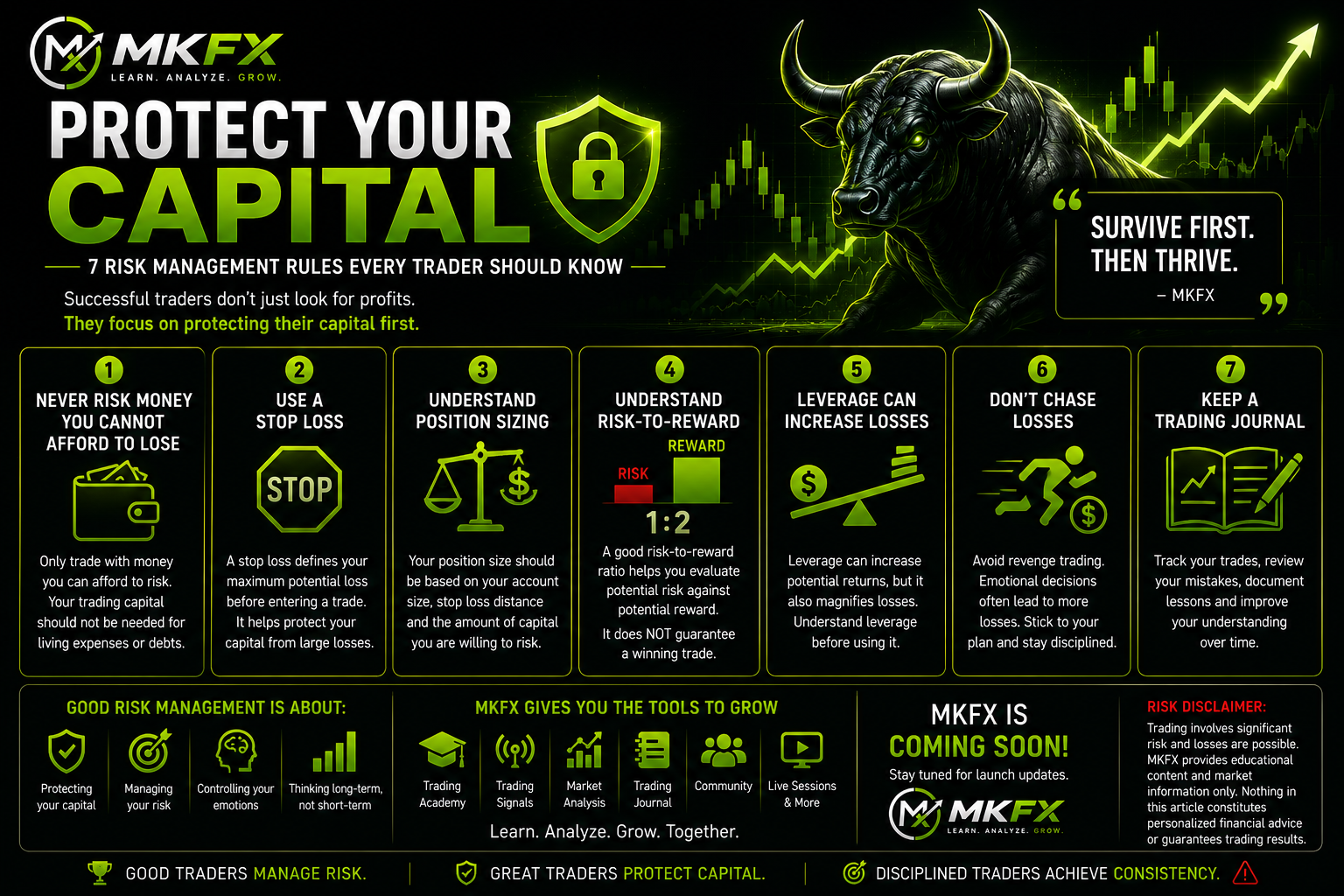
Forex Risk Management: Protect Your Trading Capital
One of the most important lessons every trader should learn is simple:
Protect your capital.
Trading is not only about finding profitable opportunities. Every trade carries risk, and losses are a normal part of participating in financial markets.
Good risk management helps traders control how much they are prepared to lose when a trade does not go according to plan.
What Is Risk Management?
Risk management is the process of deciding how much capital you are willing to risk and how you will protect yourself before entering a trade.
Instead of focusing only on:
"How much can I make?"
A trader should also ask:
"How much am I prepared to lose if I'm wrong?"
1. Never Risk Money You Cannot Afford to Lose
Trading involves significant risk.
Money required for rent, food, transport, debt repayments or other essential expenses should not be treated as trading capital.
Trading capital should always be money that you can afford to lose without affecting your essential financial responsibilities.
2. Use a Stop Loss
A Stop Loss is a predetermined price level where a trade can be closed if the market moves against the position.
It helps define the potential loss before entering a trade.
However, a Stop Loss does not guarantee an exact exit price in all market conditions. Fast-moving markets, price gaps, liquidity conditions and slippage can result in an order being executed at a different price.
3. Understand Position Sizing
Position size determines how much exposure you have to a particular trade.
A larger position can produce larger profits when the market moves in your favour, but it can also create larger losses when the market moves against you.
Your position size should therefore be considered together with factors such as:
- Account size
- Entry price
- Stop Loss distance
- Instrument being traded
- Amount of capital at risk
There is no single position size that is appropriate for every trader or every account.
4. Understand Risk-to-Reward
Risk-to-reward compares the amount you are prepared to risk with the potential reward of a trade.
For example:
- Risk: R100
- Potential Reward: R200
This would represent a 1:2 risk-to-reward ratio.
A favourable risk-to-reward ratio does not guarantee that a trade will be profitable. It simply helps traders compare the potential downside of a trade with its potential reward.
5. Leverage Can Increase Losses
Leverage allows traders to control larger market exposure using a smaller amount of capital as margin.
While leverage can magnify potential gains, it can also magnify losses.
This makes understanding leverage and margin especially important for beginners.
Having access to high leverage does not mean that a trader should automatically use the maximum amount available.
6. Don't Chase Losses
After losing a trade, some traders may immediately increase their position size or enter another trade emotionally in an attempt to recover the money.
This is commonly known as revenge trading.
Making trading decisions based on frustration, fear, greed or the desire to recover a previous loss can lead to poor risk management and additional losses.
Following a structured trading plan is generally more disciplined than reacting emotionally to the outcome of individual trades.
7. Keep a Trading Journal
A trading journal can help you understand your own trading decisions and behaviour.
Useful information to record can include:
- Market or currency pair
- Buy or Sell direction
- Entry and exit
- Stop Loss
- Take Profit
- Position size
- Profit or loss
- Reason for entering the trade
- Emotional state
- Mistakes
- Lessons learned
Over time, this information can help identify patterns in your trading decisions.
A winning trade does not automatically mean that the decision-making process was good, and a losing trade does not automatically mean that the process was bad.
The journal helps you review both.
This Is Why MKFX Includes a Trading Journal
MKFX combines trading education and market insights with practical tools designed to support a more structured learning process.
Members can learn through the MKFX Academy, review educational trading signals and market analysis, and record their own trading activity through the MKFX Trading Journal.
The objective is not to teach traders to chase profits or blindly copy trading signals.
Instead, MKFX encourages members to develop knowledge, discipline, independent thinking and a better understanding of trading risk.
A useful workflow is:
LEARN → ANALYZE → PLAN → MANAGE RISK → RECORD → REVIEW
Survive First. Then Thrive.
Financial markets will continue to present opportunities.
Protecting your trading capital gives you the opportunity to remain in the learning process rather than allowing one trade, one emotional decision or excessive exposure to determine your entire outcome.
Risk management cannot eliminate losses, but it can help create structure around how those losses are approached.
MKFX
LEARN. ANALYZE. GROW.
Powered by MKTECHSUPPORT (PTY) LTD
Risk Disclaimer: Trading involves significant risk and losses are possible. Leverage can magnify both gains and losses. Stop Loss orders may not always be executed at the exact requested price under all market conditions. MKFX provides trading education, market insights, educational trading signals and related tools. Nothing contained in this article constitutes personalised financial advice or guarantees trading results.